5/27/26
How GLP-1 Drugs Are Reshaping the Morbid Obesity Market in the US
Incidence is down, surgery is down, and the patients still reaching the operating room are sicker than they were three years ago.
How GLP-1s Are Rewiring the US Morbid Obesity Market - 5/27/26
Incidence is down, surgery is down, and the patients still reaching the operating room are sicker than they were three years ago.
For the first time in a generation, morbid obesity prevalence in the United States is moving in the right direction and the claims data shows why. Citrus analyzed longitudinal medical and pharmacy claims for more than 300 million US patients from 2020 through 2025 to measure the structural shift underway since the FDA approved semaglutide for chronic weight management in June 2021. New morbid obesity diagnoses are down 32% from their 2021 peak. Bariatric surgery volume is down 46% from its 2022 peak. GLP-1 spend in this population reached $17.5B in 2025, up from $0.7B in 2020. The therapy class is no longer arriving — it has arrived, and it is rewriting the math underneath every commercial plan in this category.
The timing matters. Global GLP-1 receptor agonist sales topped $53B in 2024, with Novo Nordisk's semaglutide franchise alone generating roughly $29B. The FDA's December 2025 approval of oral semaglutide for weight management, with a full US launch in January 2026, will pull another layer of patients into the funnel with patients who would not accept an injectable but will accept a pill. So the central question for any strategy team in this space is not whether GLP-1 disrupts morbid obesity care. It already has. The question is where the next dollar of utilization, surgery, and unmet need actually sits. The claims show it, and the picture is sharper than the press releases suggest.
The Headline Numbers
Five findings define the shift. New morbid obesity diagnoses fell 23% between 2022 and 2025, and 32% from the 2021 peak with a decline that aligns precisely with the post-approval GLP-1 ramp. Bariatric surgery volume fell 46% over the same window. GLP-1 utilization in the morbidly obese population nearly tripled, and associated spend grew more than five-fold. Surgical patients today carry comorbidity burdens 20% to 60% higher than diagnosed patients who pursue no active treatment. And the largest finding by population: nearly nine in ten patients diagnosed with morbid obesity in claims have received neither GLP-1 therapy nor bariatric surgery within the observation window. The shift is real and the gap is enormous, both at once.
Incidence Is Falling, Not Just Prevalence
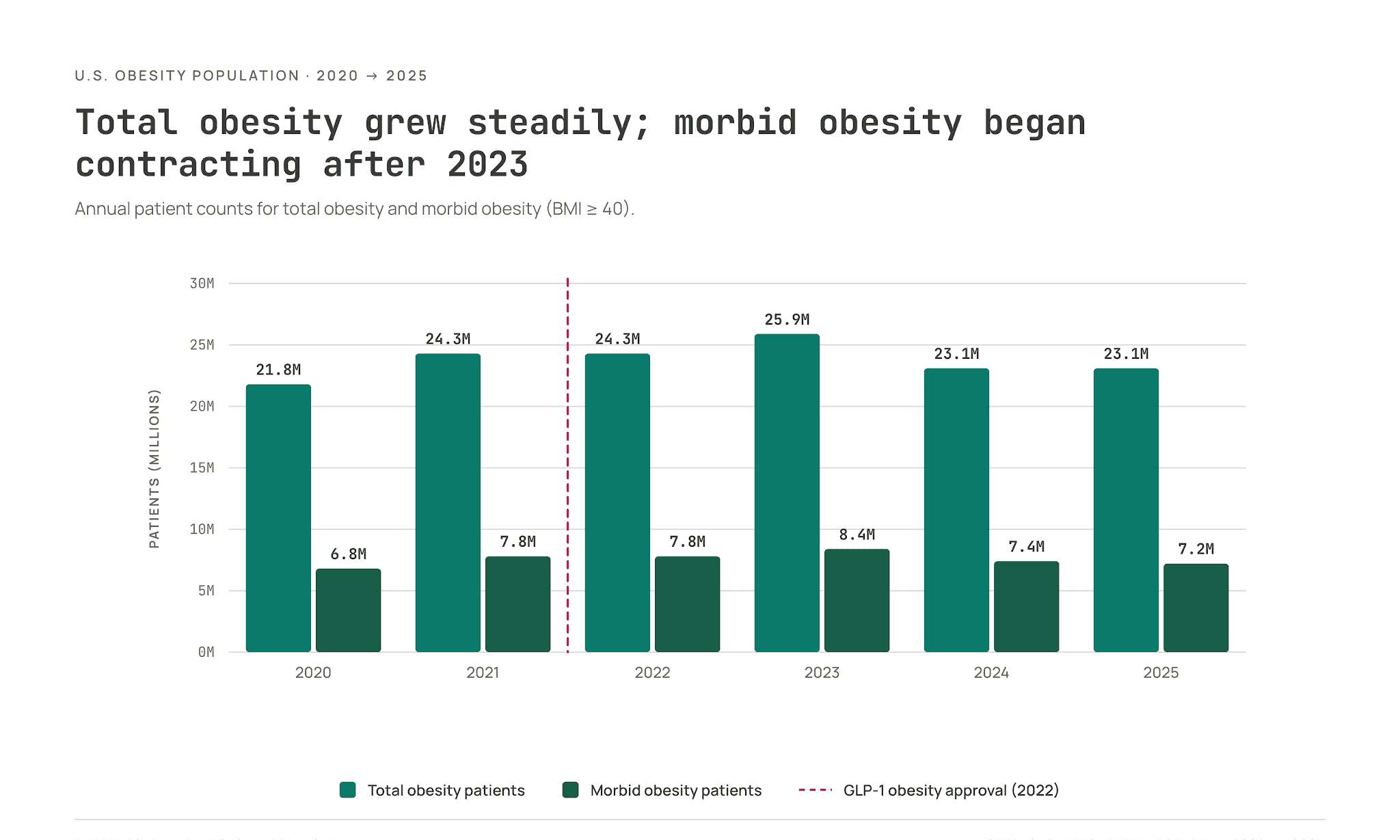
The aggregate patient count tells a flat story. Total patients carrying a morbid obesity diagnosis grew steadily from 2020 through a 2023 peak, then moderated. On its own, that looks like a market plateauing. But aggregate prevalence is the wrong number to track. Strip out patients carrying a prior-year diagnosis and look only at incidence — first-time appearance of ICD-10 E66.01 in a patient's claims history — and the trend is unambiguously downward.
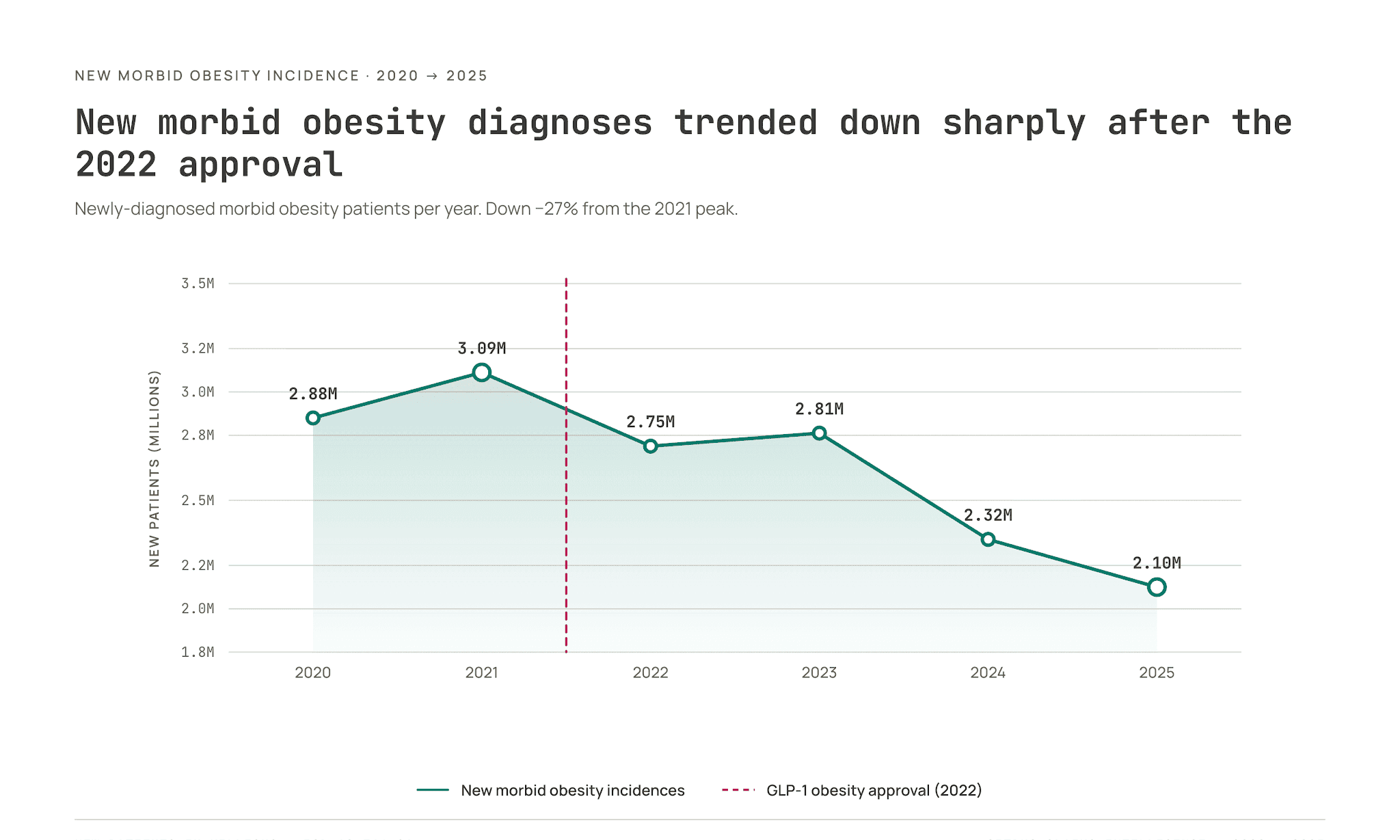
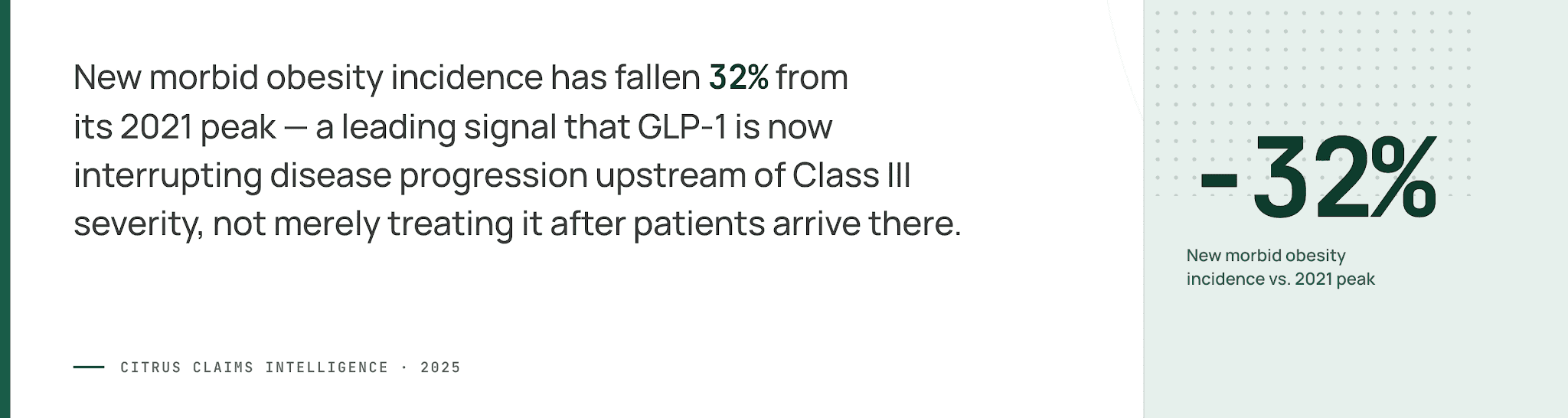
New morbid obesity diagnoses peaked at roughly 3.1M in 2021. By 2025, they had fallen to about 2.1M. The decline is not linear. It accelerates after 2022, the year semaglutide for obesity reached meaningful prescribing volume. The simplest reading: GLP-1 is preventing some share of the overweight and Class I/II obese population from progressing to morbid obesity at all. That is a different claim than "GLP-1 is treating morbid obesity," and it has different commercial implications. The market is not just being treated more aggressively and it is shrinking at the top.
One caveat worth surfacing before someone else does. 2023 shows a temporary uptick in total morbid obesity patient counts that does not fit the underlying incidence trend. The most likely explanation is a diagnostic pull-forward: clinicians coding E66.01 on patients they had not previously diagnosed in order to establish GLP-1 eligibility for prior authorization. That artifact has since normalized. The downward incidence trend through 2024 and 2025 is not a coding story.
Surgery Is Being Rationed, Not Replaced
Bariatric surgery volume peaked in 2022 and has fallen 46% by 2025. The tracking with GLP-1 uptake is tight enough that the displacement effect is hard to dispute. But the more useful finding is what happens when you split procedures by complexity, because GLP-1 has not affected all bariatric surgery equally.
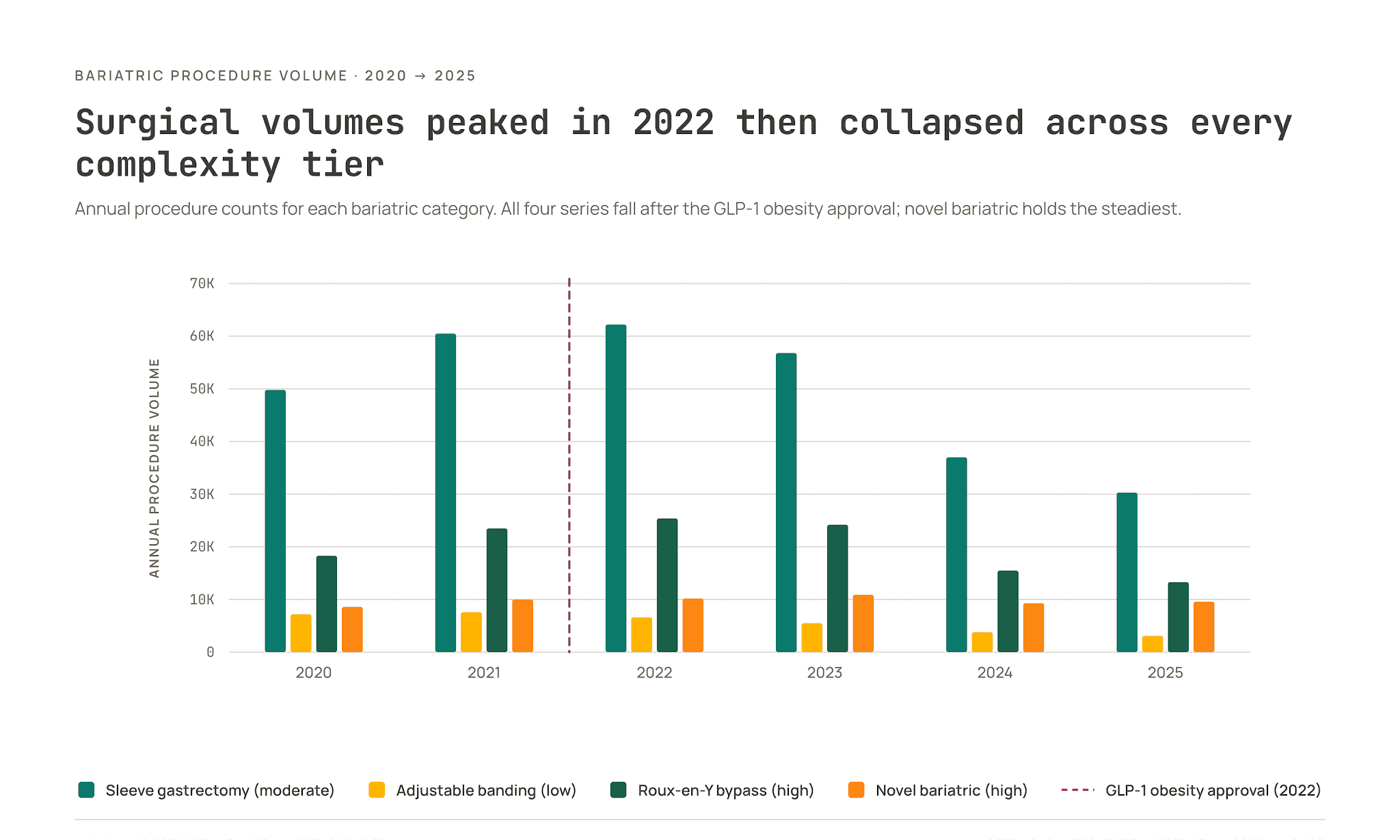
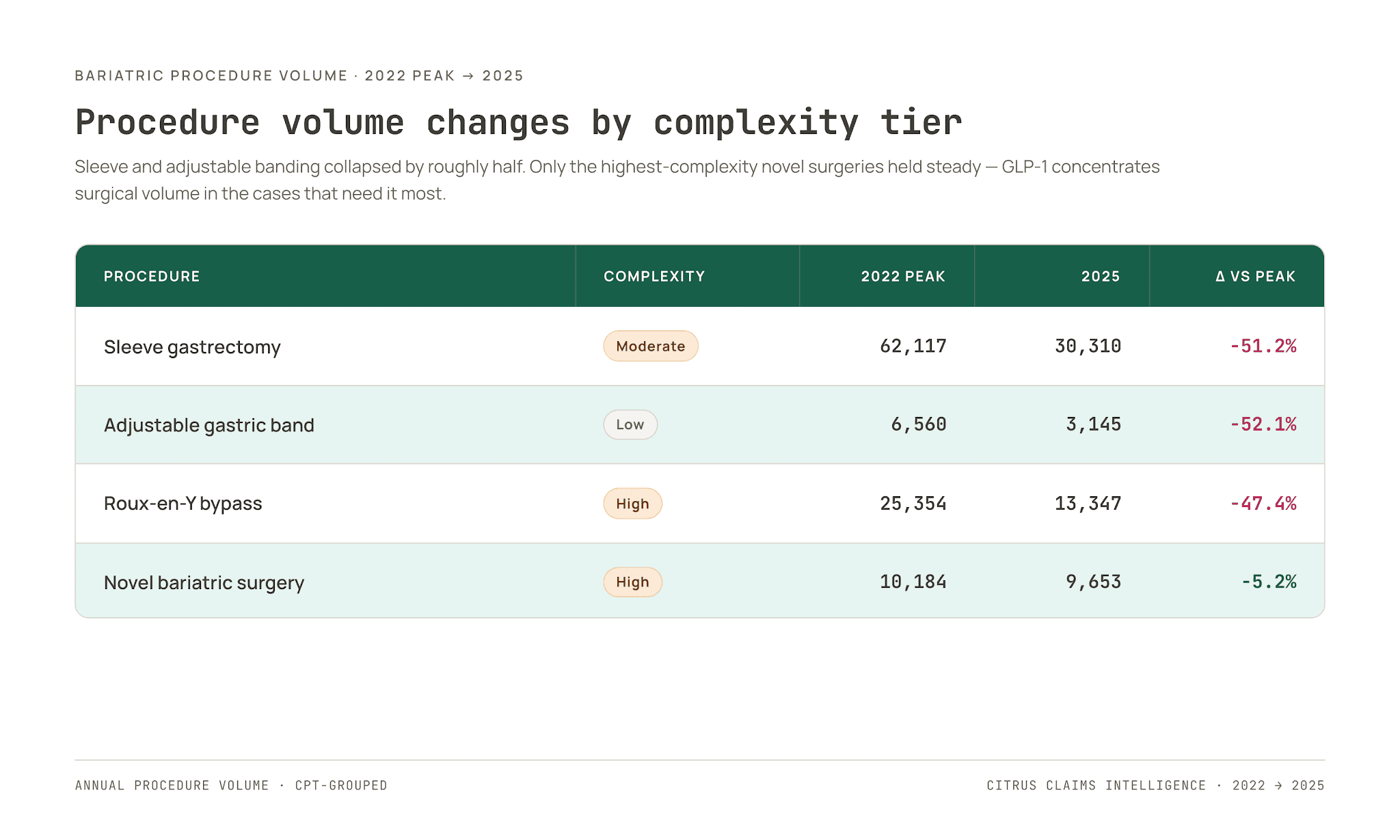
Sleeve gastrectomy, historically the dominant bariatric procedure, has fallen more than 51% from peak. Adjustable gastric banding, the lowest-acuity option, has dropped a comparable amount. These are the procedures most accessible to patients with lower comorbidity burdens and exactly the population GLP-1 is most effectively redirecting away from the operating room. Roux-en-Y bypass, which retains a clear clinical role in severe type 2 diabetes, significant GERD, and prior sleeve failure, has fallen meaningfully but less steeply. And novel high-complexity bariatric procedures have declined less than 6% from peak and have actually recovered volume since 2024.
So what does that pattern tell a strategy team? Surgery is not being substituted out of the care pathway. It is being concentrated. The patients still reaching the operating room are the ones for whom pharmacotherapy was tried, was insufficient, or was never going to be enough. That has implications for device makers, hospital service-line planners, and any payer modeling future bariatric utilization off pre-2022 baselines. Those baselines are no longer the right anchor.
The Adoption Curve in Patients, Claims, and Dollars
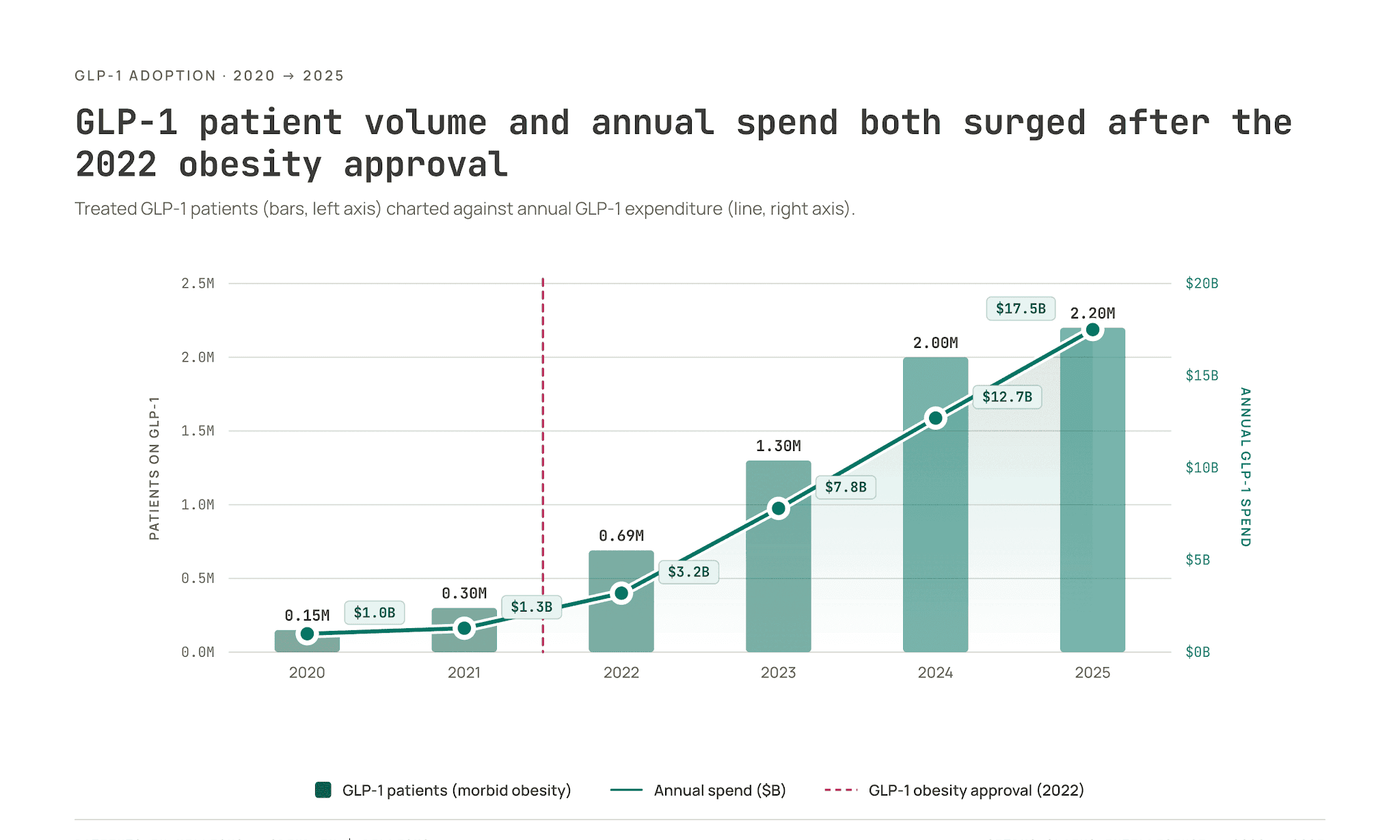
In 2020, roughly 158,000 patients carrying a morbid obesity diagnosis received a GLP-1 therapy. By 2025, that figure had grown to 2.2M and close to fourteen times higher in five years. Claim volume grew faster than the patient count, reflecting improving adherence and refill persistence as access expanded and supply normalized.
Spend grew faster still. Annual GLP-1 expenditure for the morbidly obese population reached $17.5B in 2025, up from $0.7B in 2020. That is a compound annual growth rate of roughly 88%. Per-patient spending has also climbed year over year, driven by the migration from older off-label semaglutide formulations to the dedicated obesity indications of Wegovy and Zepbound. Until oral semaglutide pricing settles or a meaningful tirzepatide alternative reaches the same indication at a lower list price, the per-patient cost trajectory is unlikely to bend on its own.
The Patient Journey in Morbid Obesity: What Claims Reveal
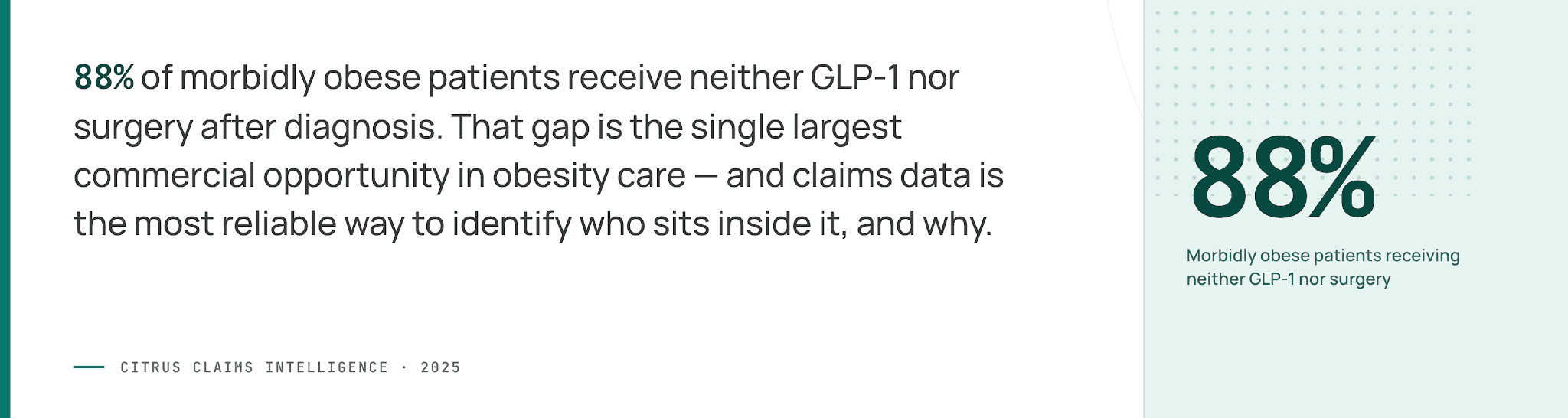
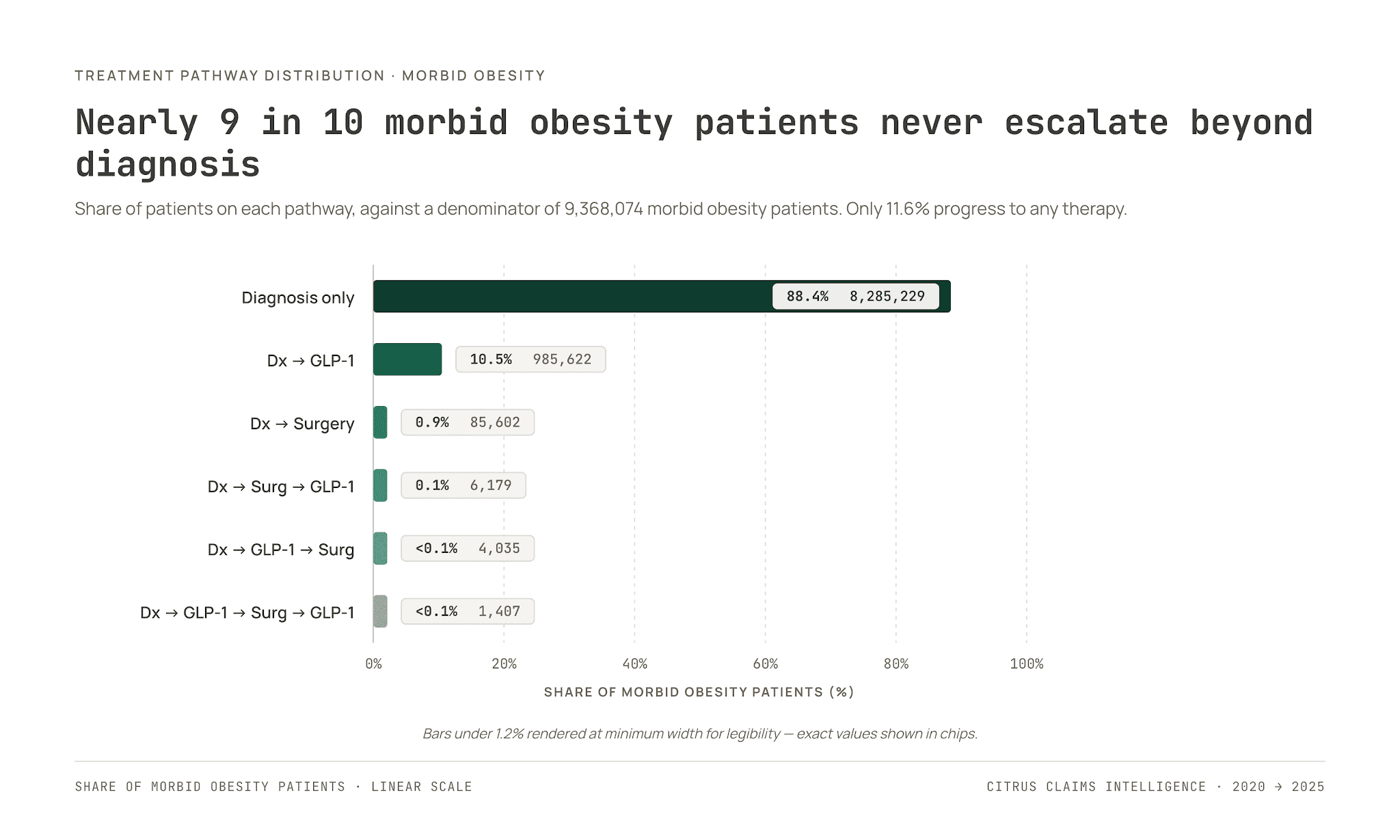
Citrus tracked the full claims journey of morbid obesity patients first diagnosed between 2022 and 2025, mapping each individual from index diagnosis through any combination of GLP-1 therapy and bariatric surgery. Of the roughly 9.4M patients in this cohort, 88% received a diagnosis and nothing further within the observation window — no GLP-1 fill, no surgical referral, no documented obesity-specific intervention of any kind. That is not noise. It is the structural reality of obesity care in the US. Stigma, prior authorization friction, coverage gaps for the obesity indication specifically, and the chronic underuse of active obesity management in primary care all contribute. So does claims maturation: some 2024 and 2025 patients have simply not had enough observation time to initiate therapy yet.
The treated population follows three patterns worth watching. Around 6,200 patients had surgery and then started GLP-1 post-operatively — an emerging strategy for managing weight regain or residual metabolic dysfunction after bariatric procedures, a pathway that barely existed in claims before 2022. About 4,000 patients tried GLP-1 first and then proceeded to surgery, the canonical pharmacotherapy non-responders or partial responders. And just over 1,400 patients traversed the full sequence: GLP-1, then surgery, then GLP-1 again. That triple-treatment group is small in count but disproportionately important in cost and complexity.
The Rising Acuity of the Surgical Patient
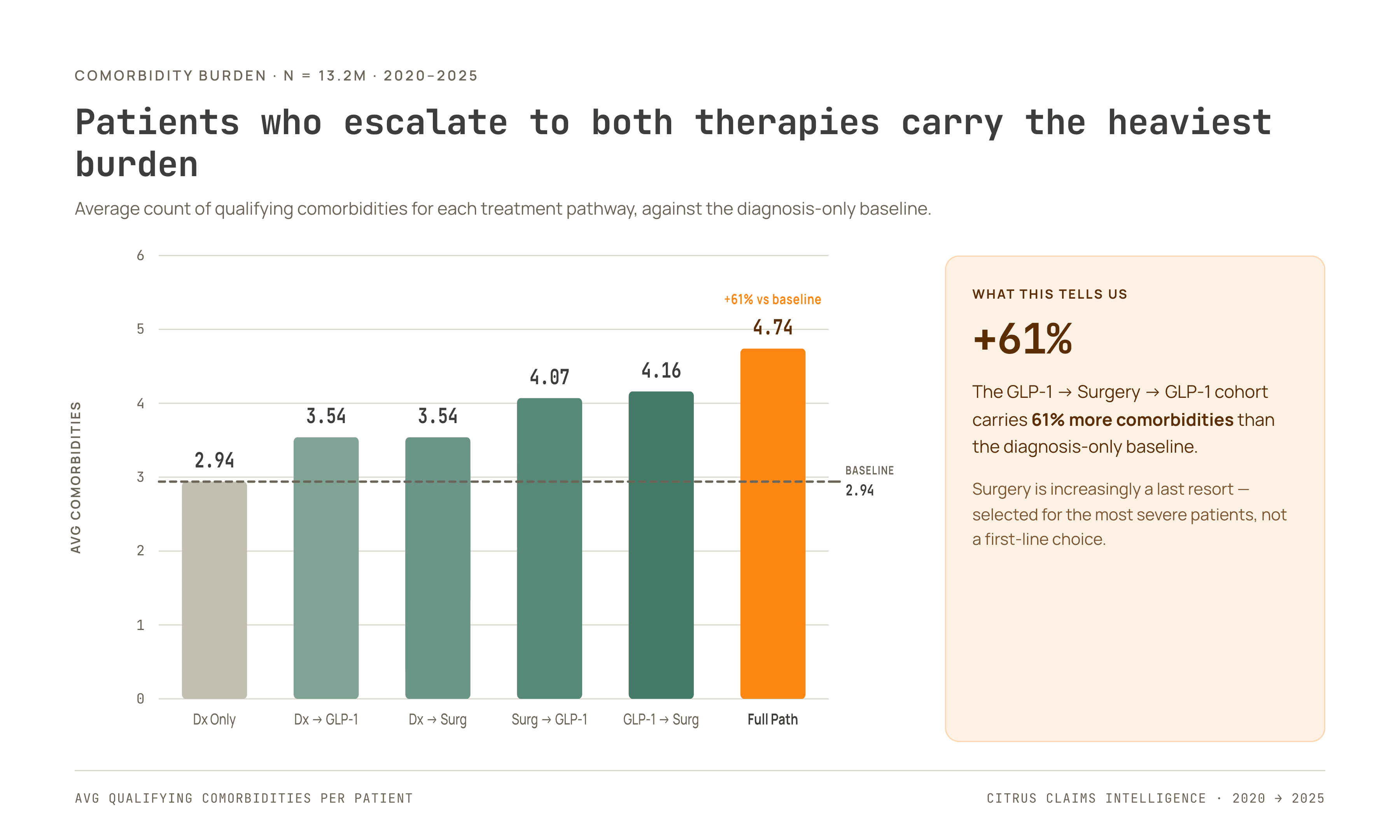
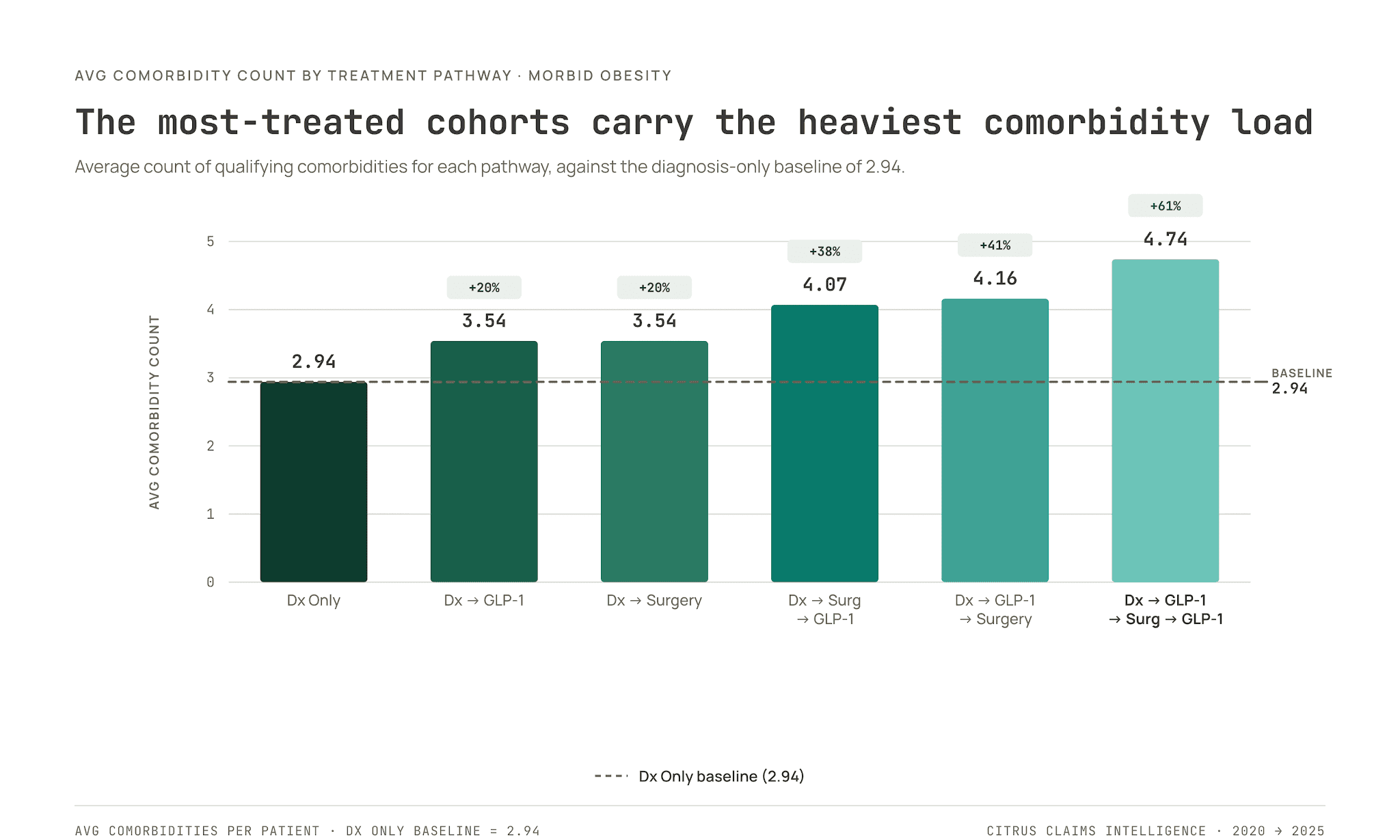
Comorbidity burden tracks closely with treatment intensity, and the pattern is consistent. Patients who receive a diagnosis and nothing further carry just under three comorbid conditions on average. GLP-1 initiators carry 3.5 which is about 20% higher, and is expected given that GLP-1 eligibility criteria preferentially capture patients with hypertension, sleep apnea, or type 2 diabetes. Surgical patients without prior GLP-1 exposure sit at a similar level, suggesting the two pathways are drawing from broadly similar disease-burden pools at the point of first intervention.
The hybrid pathways are where the acuity rises. Patients who had surgery first and then GLP-1 average 4.07 comorbidities. Those who tried pharmacotherapy and still required surgery average 4.16. Patients who completed the full GLP-1–surgery–GLP-1 sequence average 4.74 total, which is 61% above the diagnosis-only baseline. The operating room is increasingly populated by patients for whom medication alone could not carry the disease load. Surgery has not become less relevant. It has become more specialized.
Methodology
This analysis draws on Citrus' longitudinal open claims database, which covers medical and pharmacy claims for more than 300M US patients from 2017 onward. The study window is January 2020 through 2025. Morbid obesity was defined by ICD-10 code E66.01; incident diagnoses are the first appearance of E66.01 in a patient's claims history within the window. GLP-1 therapy for obesity was identified through NDC codes for semaglutide and tirzepatide in pharmacy claims, cross-referenced against a documented obesity diagnosis to isolate the obesity indication from diabetes use. Bariatric procedures were identified using CPT codes for sleeve gastrectomy (43775), Roux-en-Y gastric bypass (43644, 43645), adjustable gastric banding (43770), and novel or revisional procedures. Patient journey categories were constructed by longitudinal linkage of diagnosis, drug therapy, and surgery events.
Two caveats apply. Open claims data carries a known maturation lag with recent months are under-reported, which can compress 2025 incidence and procedure counts modestly relative to final values. And NDC-level isolation of the obesity indication is imperfect: some semaglutide use by morbidly obese patients was originally written for diabetes and later effectively serves both conditions. Where this matters for interpretation, the magnitude of the trends remains well outside any plausible noise floor.
What To Watch Next
The five-year shift is settled. The next eighteen months will decide how durable it is. Three signals matter. First, oral semaglutide's commercial launch in 2026 will test whether a pill formulation pulls a structurally different patient with one who refused or discontinued injectables into the treated population, or simply cannibalizes existing Wegovy demand. Second, payer behavior around obesity-indication coverage will determine whether the 88% untreated share contracts or hardens. Third, real-world persistence at 24 and 36 months is still poorly characterized in claims, and the discontinuation rate will determine how much of the incidence decline is prevention versus deferral. The category has changed. The question is whether the change compounds, and the claims will say so before the modeled forecasts do.
ready to build with data?
Partner with Scion to turn information into impact. Whether you're designing new systems, solving complex challenges, or shaping the next frontier of human potential—our team is here to help you move from insight to execution.